

Data is the most valuable resource in any organization. It carries the backbone of every operation; if it were somehow lost, the impact on production would be catastrophic, causing incalculable losses that could shut down any organization.
To stay away from such a bleak scenario, we recommend following this simple and very useful rule. The 3-2-1 rule was popularized by Peter Krogh, a well-known photographer who wrote that there are two kinds of people: those who have already had a storage failure and those who will have one in the future. The 3-2-1 rule means you should:
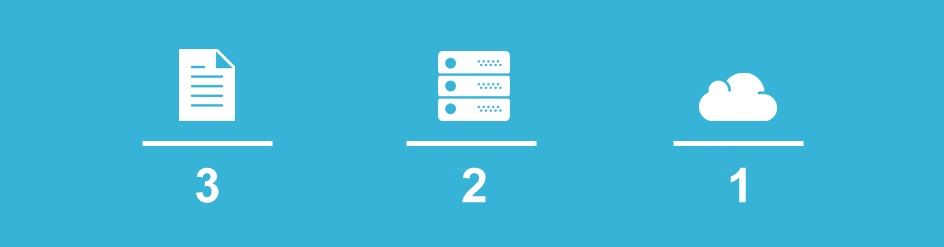
- Create 3 copies of your data (1 primary and 2 backups).
- Store them on at least 2 types of media (local drive, NAS/network, tape, etc.).
- Keep 1 copy off site (in the cloud or at a remote location).
1. Keep three copies of your data
Beyond the primary data, you should have at least two more backup copies. Why isn't one enough? A disk drive has a failure probability of 1/100; with two drives it would be 1/100 × 1/100 = 1/10,000, and with three, 1/100 × 1/100 × 1/100 = 1/1,000,000 (assuming statistically independent failures). More copies means less risk of losing data during a disaster. The third copy avoids the situation where the primary copy and its backup are stored in the same physical location.
2. Store the copies on two different media
This requirement is not met if you keep the primary data and its copy in the same place. The rule suggests keeping copies on at least two different types of storage: internal hard drives and removable media (tape, external drives, USB, SD cards, CD/DVD), or two internal drives in different locations.
3. Keep one backup copy off site
Physical separation between copies matters. Keeping the external storage device in the same room as production storage is not a good idea: if there were a fire, you would lose all your data. For small companies without branch offices, the cloud is a good option; tapes taken off site remain popular in companies of all sizes.
Author: Hidolfo Anselmi.